Future-proof your SEO strategy by creating content your audience is actually searching for
SEO Simplified will help you identify the words your audience is typing into the search bar, so you can create content that connects with humans, not just search engines.
Subscribe to get your FREE Copy of the SEO SIMPLIFIED keyword research workbook.
Jump To:
AI answers are eating the click.
You already know this. You’ve Googled something, gotten a tidy paragraph at the top, and closed the tab without clicking a single link. Your readers are doing the same thing to you.
For a while, the only real play was to write well, publish consistently, and hope the AI cited you. The algorithm decided. You didn’t.
That changed at the end of May.
Google rolled out something called Preferred Sources, and for once, it hands some of that control to a human. Specifically, to your readers. They can now tell Google which websites they trust, and those sites get a “Preferred” badge inside AI Overviews and AI Mode. When they search for something you’ve written about, Google is more likely to pull from your site to answer them.
Small businesses took a beating in the Google’s 2023 Helpful Content Update. A lot of sites that were doing everything right still lost significant traffic. Preferred Sources doesn’t undo that, but it is one of the first mechanisms Google has offered that lets independent publishers, creators, and small business owners actively compete for visibility in AI answers, rather than just waiting to be picked.
Here’s what it is, what it does and doesn’t do for your website, and how to check whether you’re eligible.
What Preferred Sources actually is
Preferred Sources is a Google feature that lets readers bookmark the websites they trust.
They go to Google’s source preferences tool, search for a site, and add it. From that point on, when they use AI Overviews or AI Mode, Google factors in their preferences and is more likely to cite those sites in the AI-generated answers they see.
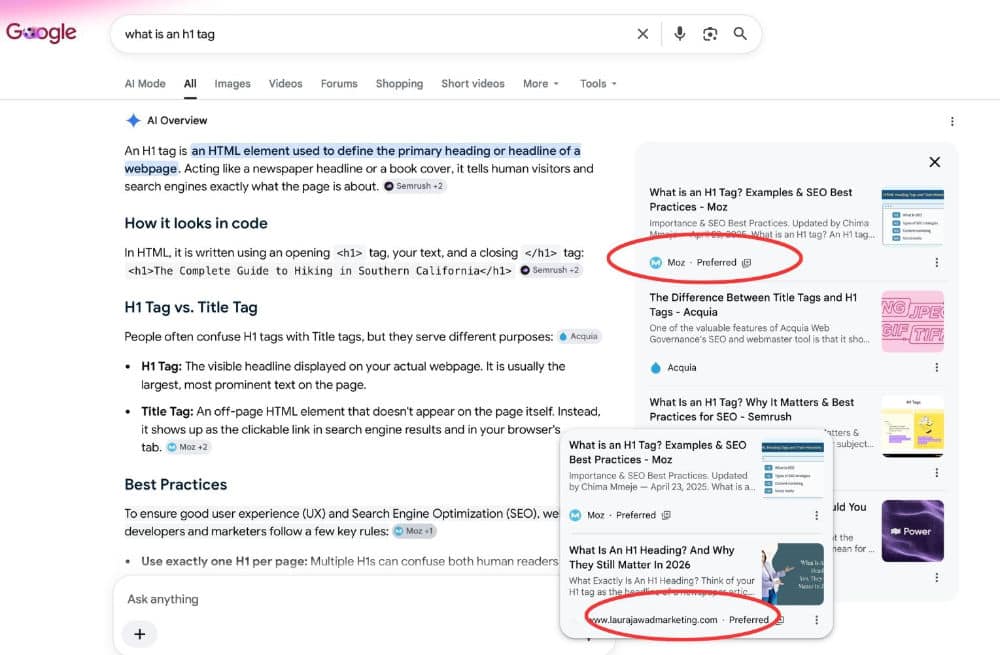
The site gets a small “Preferred” badge in their results. Nothing changes for anyone else searching the same query.
This used to be a news-publisher feature, tucked inside Top Stories and aimed at outlets like the Times and the Post. The late May update opened it to any website that publishes fresh content. That includes yours.
Two things worth knowing about the mechanics. First, it works at the domain or subdomain level. Google tracks yourdomain.com as a single preferred source. Second, the preference is tied to the reader’s Google account, so it travels with them across devices.
Why this is different from normal SEO
Most of what happens in AI search is opaque. A model ingests a question, pulls from whatever it decides is relevant, and surfaces an answer. You can optimize for it, but you can’t control it. There’s no lever to pull.
Preferred Sources is a lever.
A real human, someone who already reads your stuff and trusts you, goes into their Google settings and adds your site. That’s a deliberate act. It’s not a signal Google inferred from your backlinks or your bounce rate. Someone chose you on purpose.
That makes it categorically different from almost everything else in SEO. Keyword research, technical fixes, link building, they all influence how an algorithm perceives your site. Preferred Sources is a reader telling Google directly: when I search for something, I want this person’s answer.
For small, independent publishers and service-based businesses, that matters. The sites with the biggest SEO budgets and the most backlinks tend to dominate AI answers by default. This is one place where a loyal, engaged audience is a concrete competitive advantage, not just a nice thing to have.
What it does and doesn't do
Before you send your source preference link to everyone on your list, a few points of note.
It’s personal. When a reader adds your site, it changes what they see in AI answers. Not what the general public sees. There’s no global ranking boost here. Think of it as locking in your most engaged readers so they keep finding you, even inside AI-generated results.
It increases your chances of being cited and clicked. According to Google, when a preferred source publishes something relevant to a query, it’s more likely to be cited in that reader’s AI answer. And when it does show up, they’re about twice as likely to click through to your site. That’s a meaningful difference for a reader who’s already warm.
It’s a tiebreaker, not an override. If your site hasn’t published anything relevant to what someone’s searching for, Preferred Sources won’t conjure a citation out of thin air. You still need to publish content that matches what your readers are actually looking for. This rewards consistent publishing, it doesn’t replace it.
The short version: it amplifies what’s already working. The readers who trust you most will find you more reliably. That’s really valuable, even if it’s not a silver bullet.
Are you eligible?
Here’s the check: go to Google’s Source Preference Tool, search your domain name, and see if your site shows up.
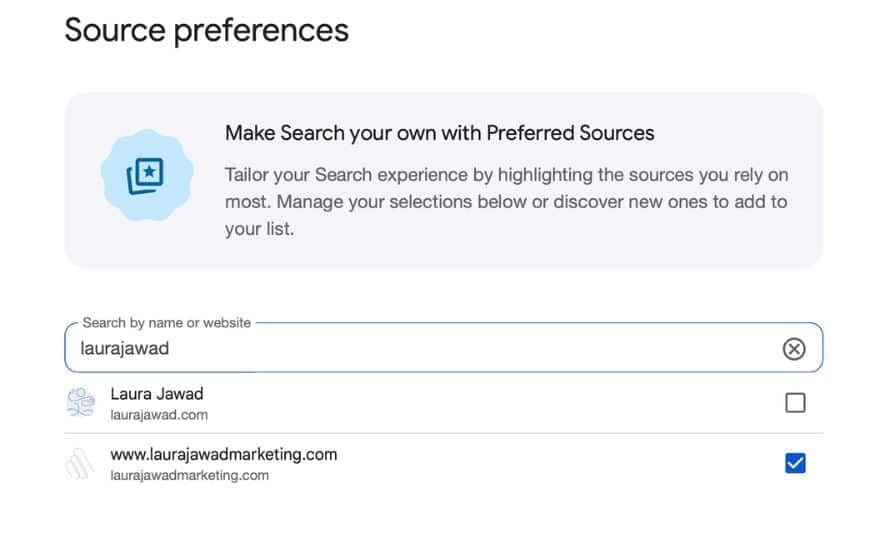
If it does, you’re eligible. That’s it.
One technical note worth knowing: eligibility is at the domain or subdomain level. yourdomain.com counts. yourdomain.com/blog does not.
If your site doesn’t show up in the tool, don’t despair. Google tends to list sites that publish consistently, so the most likely explanation is that your publishing cadence has been thin. Take it as a nudge to get some fresh content out the door. The more regularly you publish, the more likely you are to appear here, and in AI answers generally.
Not showing up today doesn’t mean you’re excluded permanently. It means you have something concrete to work toward.
How to get added as a preferred source
Two things to do with this.
First, grab your custom link and share it.
Your source preferences link looks like this: https://google.com/preferences/source?q=yourdomain.com.
Swap in your domain, test it while signed into your Google account, and send it to your people. Your email list is the obvious place. These are the readers most likely to add you, and the ones you most want showing up for inside AI answers.
Visit my custom link and add me as a trusted source by clicking this button:

Second, keep publishing.
Preferred Sources rewards exactly what good SEO has always rewarded: consistent, relevant content that your audience actually searches for. If you’ve been building that, this is one more reason it’s paying off. If you’ve been inconsistent, it’s a concrete reason to get back on track.
The throughline here is the same one that runs through every piece of SEO advice worth taking. Google keeps finding new ways to reward the sites that publish useful things regularly and build real audiences.
Preferred Sources is just the latest version of that signal, and this time, your readers get to pull the lever themselves.
Want to make sure the content you’re publishing is the kind people actually search for?
My free SEO Simplified keyword research workbook walks you through finding the right keywords for your business from scratch. Grab it here.